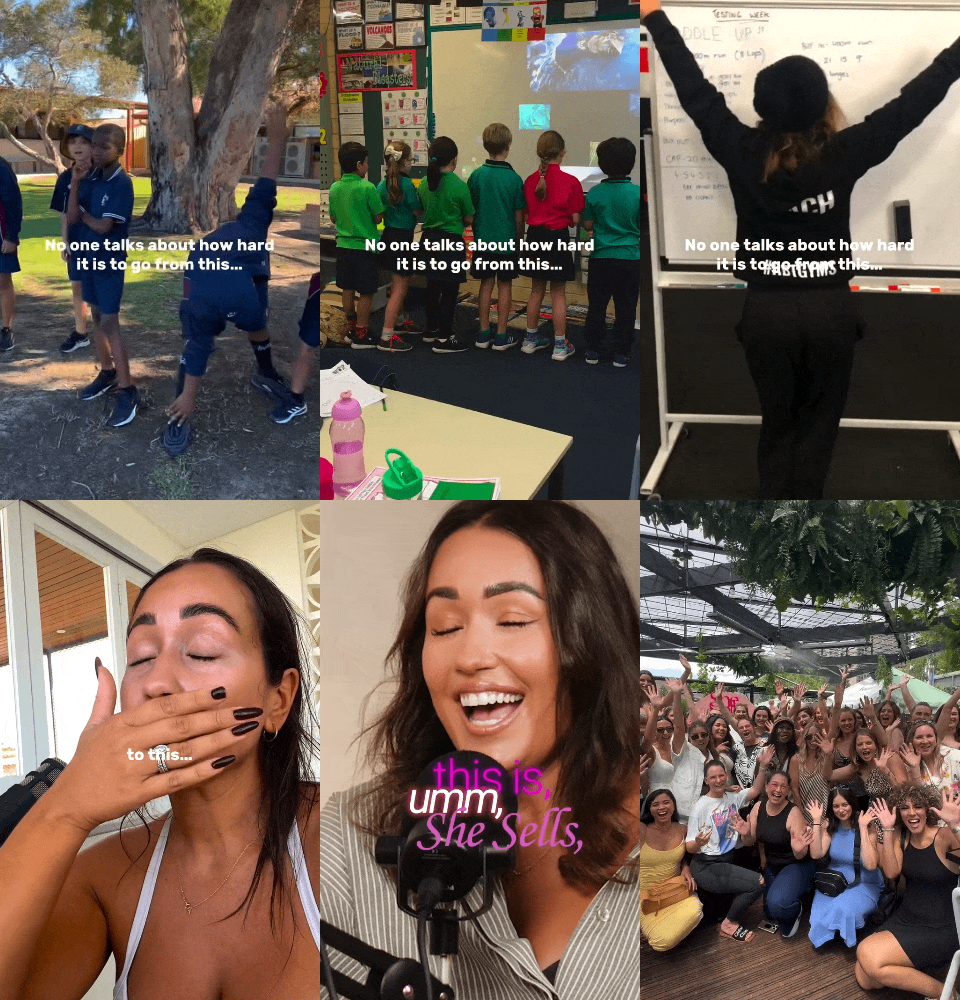
From early childhood education to remote sales
Yes, early childhood educators can move into remote sales, and appointment setting is usually the most realistic first role. The skills you use every day in a centre (talking calmly with stressed parents, holding a boundary kindly, writing clear notes, running a tight routine) map straight onto booking and qualifying sales calls. The honest catch: many remote sales roles are commission-heavy, the first months are a learning curve, and it suits people who are happy on the phone and on a screen. She Sells trains women in Australia and the US in appointment setting and closing, and its career program helps graduates land a role.
What early childhood educators bring to sales
Most people think “sales” means pushy. Good remote sales is closer to a really good parent conversation at pick-up: you listen, you ask the right questions, you explain the next step clearly and you don’t let the conversation drift. Here’s how the job you already do translates.
| What you do in the centre | What it looks like in remote sales |
|---|---|
| Handling a worried parent at drop-off without getting defensive | Handling objections on a call: acknowledge the worry, ask a question, then answer it |
| Calm boundary-setting with toddlers (and sometimes adults) | Keeping a call on track, setting the agenda and politely moving past a tangent |
| Learning stories, incident reports, daily observations | Clear CRM notes so the closer knows exactly what the lead said |
| Routines and transitions that run to the minute | Working a calendar of follow-ups, call blocks and confirmations |
| Reading a child’s mood before it turns into a meltdown | Reading tone and hesitation, and asking the question underneath the question |
| Explaining development or a new policy to families in plain words | Explaining an offer simply, without jargon or pressure |
| Following regulations and ratios to the letter | Following scripts, compliance rules and a qualification checklist |
If you’ve already read our guide on moving from teaching to sales, this is the early childhood version. Classroom teachers bring lesson planning and public speaking. Educators bring something just as useful on the phone: one-on-one warmth with adults who are often tired, anxious or rushed.
The pay numbers, side by side
Here’s what public data showed when we checked in October 2026. Every figure varies by employer, hours, location and pay structure, so treat them as a rough map, not a forecast. AU figures are in AUD and US figures are in USD.
| Role and market | What the data shows | Source |
|---|---|---|
| Early childhood educator, Australia (AUD) | Award minimum from 1 July 2026: Level 3 Qualified Educator (Certificate III) $32.47 an hour; Level 5 Advanced Educator (Diploma) $36.57 an hour; casuals get a 25% loading on top | Children’s Services Award 2010 |
| Childcare workers, US (USD) | Median $16.82 an hour in May 2025; lowest 10% under $11.66, highest 10% over $22.12 | US Bureau of Labor Statistics |
| Appointment setter, Australia (AUD) | Average $65,000 to $85,000 a year, based on full-time salary ranges disclosed in job ads | SEEK |
| Appointment setter, US (USD) | Median $16.08 an hour (10th to 90th percentile $12.74 to $20.85); total pay $28,000 to $47,000 a year, from 76 self-reported profiles | Payscale |
A few honest notes on reading that table. SEEK only counts full-time ads that show a salary, so commission-only and part-time setter work mostly doesn’t appear there. Payscale is self-reported. In the US, the gap between childcare pay and setter pay is real for many people; in Australia, it’s narrower than people expect, so the reasons to switch are often flexibility and working from home rather than a quick pay bump.
The Australian pay rise you should factor in
Australian educators have had a genuine pay change recently. The federal government’s worker retention payment is a grant paid to services that opt in, funding a 10% wage increase from 2 December 2024 and 15% from 1 December 2025, and it has been extended to 30 June 2028. So if your centre takes part, you may be earning well above the award minimums above. Check your payslip before you compare, and be honest with yourself about what you’d be giving up.
What She Sells offers here
She Sells is a remote sales program with a team in Australia and the US. “She Launches” is the foundation: live coaching, role play and frameworks for setting and closing (it doesn’t include direct placement). “She Soars” is the career program through the She Sells “Cert III in Remote Sales” certificate: once you’re certified, our recruitment team works with you to land a role within 90 days, or your money back. See our programs for the details, and note this is a She Sells certificate, separate from your early childhood qualification.
Wondering if your centre skills would work on the phone? Book a free call with the She Sells team and talk it through.
The honest differences
Educators are used to work that matters deeply and pays modestly. Sales flips some of that, and not every part of the flip feels good.
- Pay can move around. Many remote setter and closer roles are commission-heavy or commission-only, and some are contractor roles rather than employment. Ask which one you’re being offered, in writing.
- Rejection is part of the job. Plenty of leads won’t pick up, won’t book or won’t show. A tantrum in the home corner isn’t personal and neither is a “no thanks”.
- You might miss the kids. If the children are your favourite part of the day, factor that in. Sales is adults, screens and calendars.
- Less physical, more mental. No more lifting, floor time or outdoor duty, which many educators welcome. But you’ll need to build your own structure, because no roster tells you when to start.
- It takes time. I made $440 in my first month in remote sales back in 2020 (not typical, and a reminder that the start is usually slow).
A plan to switch while you’re still on the floor
You don’t need to resign to start. Most educators who make this move do it gradually, around centre shifts, so there’s still a pay cheque while they learn.
- Weeks 1 to 2: get clear on the role. Learn the difference between setting and closing, and read real job ads in your market. Our guide on getting into sales with no experience covers what hiring managers actually look for.
- Weeks 3 to 6: practise out loud. Role play calls after your shift or on your days off. Record yourself. Your parent-conversation instincts are a head start, but call structure is a learned skill.
- Weeks 6 to 10: rewrite your résumé (CV). Swap “supervised children” for what sales hiring managers want to see: communication with families, documentation, compliance, working to a schedule. Use the table above as your cheat sheet.
- Weeks 8 to 12: test the hours. Many setter roles run evenings or split shifts, which can sit alongside a 7am to 3pm centre roster. Try a few part-time hours before you drop any shifts.
- Then decide. If the work suits you, you can reduce shifts or go casual at the centre while your sales work builds. Keep your qualification current; there’s no reason to burn that bridge.
If you’re a mum as well as an educator, our list of remote sales skills you already have as a mum is worth a read too.
Red flags to watch for
Educators are trusting by nature and used to helping. Scammers know that. The US Federal Trade Commission says honest employers will never ask you to pay to get a job, and that an offer promising a lot of money in a short time with little work is almost certainly a scam. Watch for:
- Paying a fee to “unlock” a job, buy a starter kit or access leads.
- Income promises with no explanation of how commission works.
- Pay that depends on recruiting other people rather than selling a real product or service (I started in network marketing in 2014, so I know how this looks from the inside).
- No written contract, no clear pay structure, or pressure to decide on the spot.
Training you choose to pay for is different from paying an employer to hire you. Just know which one you’re looking at, and ask questions until it’s clear.
Where She Sells fits
I started as a primary school teacher in a small town, so I understand leaving a job where you care about the people in front of you. She Sells teaches the skill (appointment setting and closing) and helps you get the job. She Launches gives you the coaching and role play. She Soars adds the She Sells certificate and placement facilitation, so once you’re certified our recruitment team works with you to land a role. There’s also a free community, live events and the “She’s Not Selling” podcast if you want to learn more before deciding. Read more about Brooke or browse the FAQ.
Ready to swap the roster for your own calendar? Book a free call with the She Sells team.
Results vary. Nothing here is a promise of income. See our earnings disclaimer.
Frequently asked questions
Can a childcare worker get a remote sales job with no sales experience?
Yes, many entry-level appointment setter roles hire people without sales experience if they communicate well and can show they’re coachable. Your experience with families, documentation and routines is relevant, but you’ll still need to learn call structure and practise. Expect a learning curve rather than an instant switch.
Do I need to give up my Certificate III or Diploma?
No. Your early childhood qualification stays yours, and many educators keep casual centre shifts while they build their sales work. The She Sells “Cert III in Remote Sales” is a separate She Sells certificate and doesn’t replace or relate to your ECEC qualification.
Will I earn more in remote sales than in childcare?
It depends on the role, your market and the pay structure. Public data shows US appointment setter pay sits around or above childcare worker pay for many people, while in Australia the award rates and the worker retention payment make the gap smaller. Commission-heavy roles can pay more or less than a centre wage, so compare carefully.
Can I do appointment setting around centre shifts?
Often, yes. Many setter roles work evenings or split blocks because that’s when leads pick up, which can fit around a day roster. Ask employers about expected hours before you accept, and try a few part-time hours before you change your centre shifts.
Is remote sales a good fit for early childhood educators?
It suits educators who enjoy talking with adults, can handle hearing “no” and like structure. It’s less suited to someone who would really miss working with children or who needs a fixed, predictable wage from day one. A free call is a low-pressure way to test whether it fits.